Scanning Electron Microscopy Analysis in Houston, Texas
When an optical microscope isn’t enough, the scanning electron microscope (SEM) is where answers live. US Corrosion Services operates a dedicated SEM/EDS laboratory in Houston, providing high-resolution imaging and elemental analysis for failure analysis, corrosion investigation, materials characterization, and quality assurance. Our analysts bring metallurgical and materials science expertise to every project. We’re not just technically competent scope operators, but professionals who understand what we’re looking at and why it matters.
Pricing starts at $350/hour for technician-operated analysis, with PhD metallurgist-led sessions available at $475/hour for cases requiring real-time expert interpretation. Rush turnaround is available, including same-day and next-day analysis depending on time of receipt.
US Corrosion offers a number of advanced analytical microscopy techniques, the most of common of which is electron microscopy. In the scanning electron microscope (aka SEM), a beam of electrons is used as the light source instead of visible light. Because the wavelength of electrons is around 100,000 times smaller than photons, the electron microscope is capable of going to very high magnifications for analysis. When combined with the chemical analysis tools such as EDS, the SEM allows for super high precision analysis of materials down to the sub-micron level.
What the SEM Can Tell You
The scanning electron microscope uses a focused beam of electrons rather than visible light. Because electron wavelengths are roughly 100,000 times smaller than photons, the SEM achieves magnifications and resolution that no optical microscope can approach. SEMs easily show features at the sub-micron level that are entirely invisible to conventional imaging or optical microscopy.
In practice, this means we can examine fracture surfaces and determine whether a crack propagated by fatigue, overload, hydrogen embrittlement, or stress corrosion. We can image corrosion morphology in detail, distinguishing pitting from crevice attack from intergranular corrosion. We can evaluate weld microstructure, characterize coating failures, identify foreign material contamination, and assess particle morphology, all with the kind of resolution that makes root cause conclusions defensible.
EDS: Elemental Analysis in the SEM
Most of our SEM work includes energy-dispersive X-ray spectroscopy (EDS), which provides semi-quantitative elemental composition of whatever the electron beam is striking. When the beam excites atoms in the sample, characteristic X-rays are emitted. Each element produces a unique spectral signature, allowing us to identify and quantify the elements present at any point on the surface.
This is particularly valuable in corrosion and failure analysis. A fracture surface that appears clean under an optical microscope may show high chloride concentrations under EDS, which explains evidence of pitting or stress corrosion cracking. A coating delamination may reveal oxidation products or contamination at the interface. A weld heat-affected zone may show localized elemental segregation that explains why it failed at a fraction of its rated strength.
EDS spectra can be collected at discrete points, along line profiles, mapped rectangular areas, or as full elemental maps across an area of interest. Interpreting the results correctly requires experience, because peak overlaps between certain elements (titanium and barium, for example, or vanadium and chromium) require an analyst who understands the material system and knows which interpretation is chemically plausible. Fortunately, we’ve dealt with this a lot. On top of that, we have a variety of other available tools like XPS, FTIR, XRD, DTA, DSC, ICP-OES, and more available to help if EDS cannot clearly distinguish.
Common Applications
Our SEM/EDS capability supports a wide range of industries and investigation types:
- Failure Analysis and Fracture Characterization
SEM fractography is one of the most powerful tools in failure analysis. Fracture surface morphology evidence like striations, dimples, intergranular features, or cleavage facets tell the story of how and why a component broke. Combined with EDS and stereo microscopy, we can connect fracture morphology to environmental chemistry and thus identify contributing embrittlement or corrosive mechanisms. [→ See our Failure Analysis services] - Corrosion Investigation
Identifying corrosion products, characterizing attack morphology, and determining the chemistry at corroded surfaces. This is foundational work in corrosion root cause analysis for oil and gas, chemical processing, marine, and industrial facilities. [→ See our Corrosion Analysis services] - Weld and Material Quality Assessment
Microstructural evaluation of welds, heat-affected zones, base metal, and heat treatment response. We regularly support weld procedure qualification, production quality audits, and post-failure weld investigations. - Coatings and Surface Analysis
Characterizing coating thickness, adhesion failure, delamination interfaces, and surface contamination. Useful for paint and coating failures, galvanized layer assessment, and plating quality. - Foreign Material Identification
When a particle, deposit, or contamination needs to be identified, EDS provides a fast and reliable elemental fingerprint. We routinely identify corrosion products, process deposits, inclusions, and debris from industrial equipment. - Particle and Powder Characterization
Morphology, size distribution, and elemental composition of powders, particulates, and precipitates across a range of materials including metals, ceramics, and polymers.
Our Capabilities and Equipment
Our Houston SEM laboratory is equipped and staffed for analytical work across metals, polymers, ceramics, composites, and geological materials. Capabilities include:
- High-resolution secondary electron (SE) and backscattered electron (BSE) imaging
- Energy-dispersive X-ray spectroscopy (EDS) for point analysis, line/area scans, and elemental mapping
- Low-vacuum operation for non-conductive and moisture-sensitive samples
- Cross-section preparation and metallographic polishing for microstructural analysis
- Carbon and gold/palladium sputter coating for non-conductive samples
- Integration with optical microscopy, XRD, FTIR, and mechanical testing for comprehensive materials characterization
For projects that require chemical analysis beyond EDS, including phase identification, polymer characterization, or surface chemistry, we offer complementary techniques including XRD, FTIR, and XPS. Our team can help you determine the right combination of tools for your specific question or application.
Turnaround and Pricing
We understand that many SEM requests are tied to active investigations, production holds, or legal matters where time is a factor.
- Standard turnaround: Typically 3–5 business days for analysis and report
- Rush (same-day/next-day): Available depending on time of receipt and scope of analysis. Please contact us to confirm availability
- Remote project support: We can conduct analysis with a client representative present or provide real-time video access to the scope session for remote clients
- Pricing: Technician-operated SEM/EDS from $350/hour | PhD metallurgist-operated from $475/hour
Pricing includes instrument time, analysis, and a qualified operator. Report preparation is quoted separately based on scope. For most straightforward SEM/EDS jobs with a few samples, a specific question, a clear deliverable, the total cost typically falls in the $500–$2,500 range. Complex investigations with multiple samples and full written reports are quoted case by case.
Why US Corrosion Services for SEM/EDS?
There’s no shortage of facilities with an SEM. What’s harder to find is a team that connects the data to a defensible, useful answer. Our analysts hold advanced degrees in metallurgy and materials science, so the same people who operate the instrument are the ones who interpret the results and write the report. We don’t hand your samples off to a technician who produces a stack of spectra and leaves you to figure out what they mean.
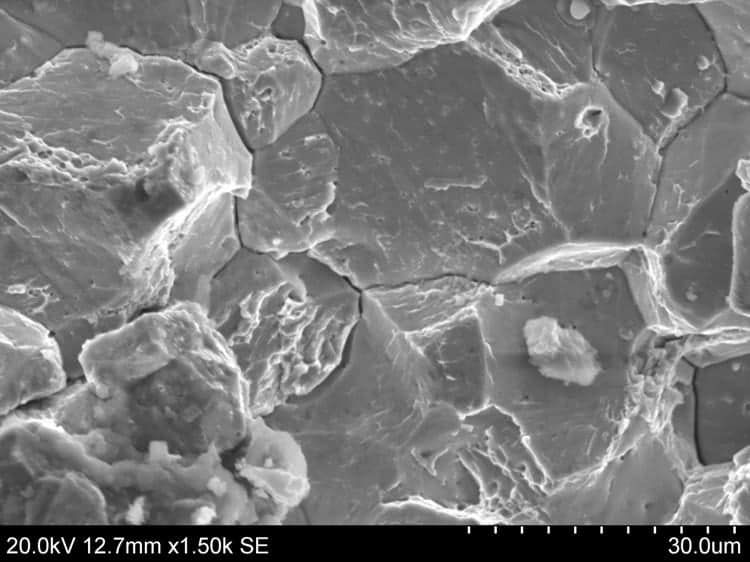
We’re also not a generalist testing lab trying to do everything. Corrosion, failure analysis, and materials characterization are the core of what we do. When your SEM results point toward a stress corrosion mechanism or a weld metallurgy problem, we have the depth to follow it wherever it leads. For example, the electron microscope in our Houston electron microscopy laboratory is often used for failure analysis. In the case below, a sample suspected of failure by hydrogen embrittlement was evaluated to determine the nature of the fracture surface (a practice known as fractography). The intergranular fracture seen is a clear indicator of hydrogen embrittlement:
Our laboratory is located at 8307 Kempwood Dr., Houston, TX 77055, just off Hempstead Highway at Bingle road in Houston, Texas. We offer sample pickup and delivery service throughout the Houston area, and we ship and receive samples nationwide and globally.
Frequently Asked Questions
How do I prepare samples for SEM analysis?
For most metallic samples, no preparation is needed. Just avoid cleaning fracture surfaces or corroded areas with solvents or abrasives before shipping, as this can destroy the evidence we need. For cross-section or microstructure work, we’ll handle all mounting and polishing in-house. If you’re not sure how to handle your sample, call us first! We are happy to help provide guidance.
Can you analyze non-metallic materials?
Yes. We regularly analyze polymers, ceramics, coatings, geological samples, and composite materials. Non-conductive materials are analyzed under low-vacuum conditions or after sputter coating. We also have additional analytical capabilities
What does an SEM/EDS report include?
Reports include high-resolution SEM images at relevant magnifications, EDS spectra and elemental composition data, and a narrative interpretation of findings. For failure analysis cases, findings are integrated into the broader root cause discussion. We can tailor report format to litigation support, quality system, or internal engineering requirements.
Do you offer on-site SEM analysis?
Our SEM instrument is laboratory-based. For large components that can’t be sectioned or shipped, we can evaluate representative samples cut from the component of interest. Contact us to discuss sampling strategy.
How does SEM/EDS compare to XRF?
X-ray fluorescence (XRF) is fast and useful for bulk elemental analysis, but it averages across a relatively large area and can’t localize chemistry to specific features. SEM/EDS can analyze spots as small as a few microns, making it far more useful for investigating localized corrosion, inclusions, fracture surface chemistry, and interface composition. However, XRF is nice because we can do it in the field. We offer XRF testing services throughout the US as well from our Houston HQ.
Have a sample that needs SEM analysis?
Tell us what you’re looking at and what question you need answered. We’ll let you know what’s possible, what it will cost, and how fast we can get it done.
Localized Chemical Analysis in the SEM
SEM images can tell you a lot, but most modern systems also often include one or several types of additional analyzers for local chemical and crystal structure analysis. These tools can help separate and map the chemical or crystal structures of anything visible in the SEM, although they generally work better on metals and organic materials than polymers or ceramics. We use the combined SEM and chemical data for analysis such as:
- Fractography of failed components, where we study the cracked area to evaluate they it occurred,
- Analyzing residues on corroded or damaged components,
- Confirming or evaluating hydrogen embrittlement and other types of failures,
- Testing contaminants from plastics, foods, and medical processes or products,
- Evaluating carbides, precipitates, sensitization, and other microstructure features, and
- High-resolution analysis of field metallurgical replica samples taken in-situ.
Our Houston SEM testing capabilities include energy dispersive X-ray spectroscopy (EDS), wavelength dispersive X-ray spectroscopy (WDS), and electron backscatter diffraction (EBSD), three powerful chemical and crystal structure analysis tools. Each has its own special set of capabilities, which are described in more detail below:
What is EDS?
Energy dispersive x-ray spectroscopy (often called EDS or EDX) measures the energy of x-ray’s being emitted by the atoms being analyzed. A high-energy beam of x-rays strikes the atoms, bumping electrons out of their ground state shell. When this happens, other electrons falls from higher shells to take the empty spot, and in doing so emit an x-ray whose wavelength is equivalent to the energy difference between the two shells. The unique atomic structure of each elements results in a characteristic spectra being developed, and analysis software is then used to determine the percentage of each element present. The EDS detector measures the emitted x-rays, converting them into a graph based on energy (in KeV) like this:

From this spectra, analytical software can be used to determine the semi-quantitative elemental composition. Due to the overlap that occurs between some elements (where the peaks are in nearly the same position), it is important to have a skilled electron microscope operator who can determine which element is more likely to be present. In addition, we have an extremely diverse set of calibration standards that can be used to further improve the accuracy of our chemical element measurements. The data is tabulated in both atomic and weight percent, like so:

What is WDS?
Similar but different: wavelength dispersive x-ray spectroscopy evaluates the wavelength of x-rays to determine the elements from which the are emitted. WDS also generates a spectra, which is evaluated using Bragg’s law to determine the wavelength of each emitted x-ray. These can again be evaluated based on their connection the atomic structure to produce spectra and to determine the elements present. WDS provides superior spectral resolution, but takes substantially longer so in most cases EDS is preferred for faster analyses.
What is EBSD?
EBSD (electron back-scatter diffraction) is a powerful technique for evaluating the crystal structure of metals and other crystalline materials. It is often used for advanced metals and alloys, such as turbine blades and other shape-sensitize materials.
What other chemical analysis techniques do you offer?
We provide a wide range, including XRD, FTIR, XPS, and more! Together, they can evaluate metals, plastics, concretes, rocks, hydrocarbons, surfaces, and more. Some techniques provide details on the elements present, while others (like XRD) can determine which compounds are involved. Contact us if you need help determining the right chemical analysis tool for your application.
Where can I get electron microscope analysis in Houston?
Our Houston electron microscopy lab is located at 8307 Kempwood Dr. in Houston, just off of Hempstead Hwy in the northeast corner of town. We offer inexpensive sample pickup and delivery services, and rapid testing capabilities. When you need rush SEM analysis, we can often get your samples analyzed and reports generated on a same-day or next-day basis (depending on time of receipt and analysis needed).
What is the Cost of Scanning Electron Microscopy:
Our pricing starts at $350/hour, including an experienced SEM technician to operate the scope. Alternatively, we can provide an expert-level PhD metallurgist to operate the scope and provide real-time feedback for both on-site and remote analysis for $475/hour. US Corrosion also provides extensive other services including mechanical testing, sample preparation, chemical analysis, consulting, and failure analysis – for more detailed price info on SEM or other services, please get in touch.
Why Trust US Corrosion Services?
- State-of-the-Art Equipment: We utilize the latest electron microscope technology ensuring crisp, detailed images and precise data.
- Experienced Team: Our analysts bring years of expertise to each project, ensuring accurate and actionable insights.
- Tailored Analysis: Every client’s needs are unique – we customize our approach to deliver targeted results.
- Fast Turnaround: When urgent results are needed, we ensure timely analysis without compromising on quality.