Corrositex is a humane in vitro skin corrosion test that stands in for the rabbit skin test when you need to assign a UN or DOT packing group to a Class 8 corrosive material. We run it in our Houston corrosion testing laboratory per OECD Test Guideline 435, usually have a result the day the samples arrive, and can follow up with the steel and aluminum corrosivity test when a material turns out to be non-corrosive to skin. If you need to classify an acid, base, or similar product for shipping, this page explains how the test works, what it can and can’t tell you, and how to get samples to us.
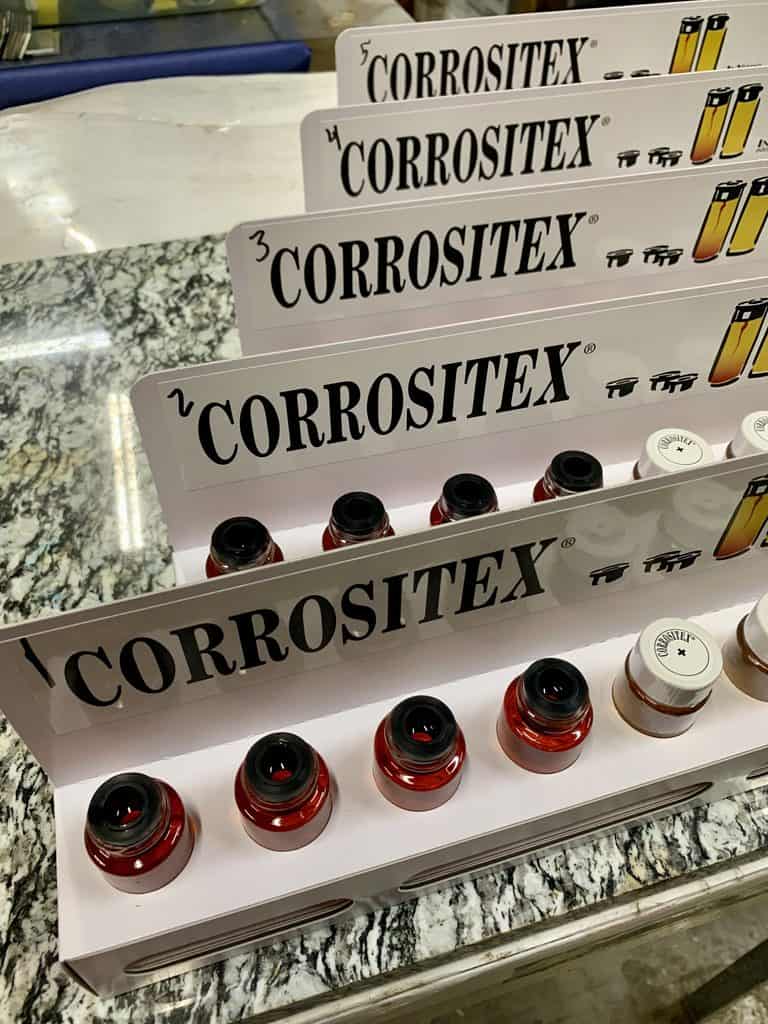
What is Corrositex Skin Corrosion Analysis?
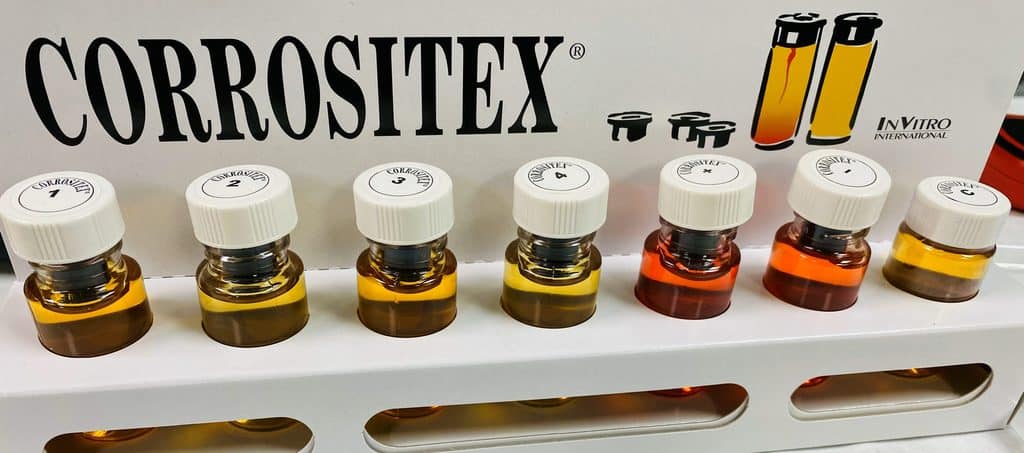
Corrositex is a membrane barrier test for skin corrosion, published as OECD Test Guideline 435 and made by In Vitro International. Each test vial holds a proprietary biobarrier membrane sitting over a chemical detection system, a liquid that changes color when the test material breaks through the ‘skin’. We put a measured amount of the sample on the membrane, start a timer, and watch for the color change. The time to break through is the key result. Shorter breakthrough times mean a more corrosive material and a more restrictive packing group, and a material that doesn’t break through within the time limit for its category is classified as non-corrosive to skin. The method was validated by ICCVAM and ECVAM as a replacement for the rabbit skin corrosion test, and US DOT names it in 49 CFR 173.137 as an accepted way to assign packing groups.
How does Corrositex work?
A Corrositex run has main three parts:
- Qualify test. A small amount of sample goes into the qualify vial to confirm the material will produce a color change in the detection system. If nothing happens within about five minutes the material doesn’t qualify and can’t be classified by Corrositex. This happens fairly often with near-neutral aqueous products, so it’s worth sending us an SDS ahead of time so we can tell you whether the test is likely to work before you ship samples.
- Categorization. The sample goes into two more vials that sort it into time scale category 1 (high acid or alkaline reserve) or category 2 (low reserve). The category sets the breakthrough time limits used in the next step.
- Breakthrough timing. Four replicate vials each with a membrane disc and about 150 µL of liquid or 100 mg of solid, run alongside a nitric acid positive control, 10% citric acid negative, and a blank. We record the time to color change in each vial and report the mean. The positive control has to break through in 1 to 3 minutes for the run to be valid, which is one of the checks that makes the method reproducible from lab to lab.
| Result | Category 1 (high reserve) | Category 2 (low reserve) | GHS skin corrosion |
| Packing Group I | 3 minutes or less | 3 minutes or less | 1A |
| Packing Group II | over 3 minutes to 60 minutes | over 3 minutes to 30 minutes | 1B |
| Packing Group III | over 60 minutes to 4 hours | over 30 minutes to 60 minutes | 1C |
| Non-corrosive to skin | over 4 hours | over 60 minutes | not classified |
Why Use Corrositex for Skin Testing?
There are several good reasons to use Corrositex simulated skin testing for Packing Group determination:
- The test is humane, using a simulated skin instead of live animals.
- Corrositex is highly reproducible. Thousands of tests have been performed to validate the Corrositex process.
- Speed: Corrositex can be run in one day, compared to live animal tests that can take weeks.
- Cost: Corrositex is a more economical alternative to animal testing.
Even for samples with dyes or heavy coloring, Corrositex can be accurately performed. It’s a key part of the Packing Group determination process, which helps legally determine how materials need to be packaged for shipping.
How long does Corrositex testing take and what do we need from you?
The test itself takes a few hours once samples are in the lab, and with notice we can often give you a verbal result the same day. Our normal turnaround for the written report is 3 to 6 business days, and rush service in 1 to 2 days is available for most jobs. We can test one sample or dozens in the same batch. Our Houston Corrositex testing lab can help test one or dozens of samples in your required time frame.
To get started, send us the number of samples, an SDS or basic chemistry for each one, and about 25 mL or 25 g of each product in a sealed, labeled container. Samples ship to our lab at 8307 Kempwood Dr., Houston, TX 77055. If you’re not sure whether your product will qualify, send the SDS first and we’ll tell you before you ship anything.
Is Corrositex accepted by DOT and other regulators?
Yes. 49 CFR 173.137 names OECD Test Guideline 435 as a method for assigning Class 8 packing groups, alongside the in vivo OECD 404 rabbit test. OECD adopted TG 435 in 2006, ICCVAM recommended the method in 1999 as a stand-alone test for acids, bases, and acid derivatives, and ECVAM endorsed it in 2000. Our reports cite the guideline and the regulation so your classification is traceable to the method.
We’re not a GLP facility. GLP is not required for DOT shipping classification, and our work runs under the quality system described on our quality assurance page. If a regulatory submission requires GLP, tell us up front and we’ll help you find a lab that can provide it.
What Are the Advantages of Corrositex Skin Corrosion Testing?
Corrositex works best on the chemistries it was validated for: acids, bases, and their derivatives. The DOT list of classes it accepts the test for is acids, acid derivatives, acyl halides, alkylamines and polyalkylamines, bases, chlorosilanes, metal halides, and oxyhalides. Liquids and solids both work, water soluble or not, and dyed or dark products usually don’t interfere because we read the detection system for a change rather than an absolute color.
What doesn’t work is any material that fails the qualify step. That is common for aqueous products between roughly pH 4.5 and 8.5 and for products with little acid or alkaline reserve. For those we can run the DOT corrosivity to metals test described below, or arrange an OECD 431 epidermis test through a partner lab and manage the project as part of our corrosion testing services.
In practice the samples we see most are industrial cleaners, descalers and etchants, acid and caustic blends, water treatment and oilfield chemicals, and raw materials headed into cosmetic or pharmaceutical formulations.
Applications of Corrositex skin corrosion testing
Corrositex skin corrosion testing is widely used in various industries to assess the safety and corrosive potential of chemicals and products. Some of the applications of Corrositex include:
- Chemical industry: Corrositex is used to evaluate the corrosive potential of industrial chemicals, such as acids, bases, and solvents.
- Cosmetics industry: Corrositex is used to assess the skin corrosivity of cosmetic products, such as creams, lotions, and hair dyes.
- Pharmaceuticals industry: Corrositex is used to evaluate the corrosive potential of pharmaceutical products, such as topical medications.
- Consumer product industry: Corrositex is used to assess the corrosive potential of consumer products, such as cleaning agents and detergents.
Additional related tests for skin and eye irritation are also available.
Should I Do Corrositex Testing Myself or Use a Qualified Lab?
It really depends! If you plan to test many materials and want to reduce costs, you can do it yourself. However, if you need results from an experienced lab whom you can count on without the learning curve and effort of running the tests, we would love to help.
We follow the OECD guidelines, part of the globally harmonized system. These methods are validated and accepted across the world. Our experts have performed hundreds of these tests and we are ready to help you.
Is Metals Testing Required for Packing Group Determination?
If your sample is non-corrosive to skin, then metals testing is required. A material that passes Corrositex can still be a Class 8 corrosive if it attacks metal. 49 CFR 173.137 assigns Packing Group III to anything that corrodes steel or aluminum faster than 6.25 mm (0.25 inch) per year at 55 °C, tested per Section 37.4 of the UN Manual of Tests and Criteria.
We run this test in-house on the specified steel and aluminum, following the UN procedure and ASTM G31 practice for mass loss, and we keep coupons on hand so there’s no lead time. The exposure runs seven days, so a sample that needs both tests usually takes 8 to 10 business days end to end. If you run Corrositex yourself and only need the metals test, we can do that too. The same corrosion coupon and mass loss methods are part of our everyday work.
How to Test for Eye and Skin Irritation:
For products that may be handled or which may cause eye irritation, we can also provide a rapid test to determine if skin or eye irritation will occur.
Where Can I Find Experts in Corrositex and Metals Testing?
You’ve come to the right place! Packing group assignments sometimes end up in disputes: a shipment rejected by a carrier, a product reclassified by a customer, or an incident investigation after a leak. Our experts provide legal support for litigation regarding corrositex, metals testing, and packing group determination. We’ve provided expert witness and litigation support on corrosivity classification, Corrositex results, and metals corrosivity, and our principal engineer is a licensed PE and court-qualified expert in corrosion. For broader questions on material compatibility or product chemistry, our corrosion consulting and metallurgical consulting groups work with the same lab.
What are the Limitations of Corrositex skin corrosion testing?
While Corrositex is an effective method of testing skin corrosivity, there are some limitations to its use. These include:
- It only classifies materials that qualify. A product that doesn’t produce a color change in the detection system can’t be tested, however corrosive (or benign) it is.
- It measures corrosion, not irritation or sensitization. A non-corrosive result doesn’t mean a product is safe to handle regularly.
- It predicts the local effect on skin only but nothing about inhalation, ingestion, or systemic toxicity.
- It isn’t suited to gases or to materials outside the validated chemical classes, where DOT may expect a tiered approach or an in vivo test.
- It doesn’t address corrosion of metals, which is a separate criterion under 49 CFR 173.137 and a separate test.