Need ASTM B611 Abrasion Testing for Tungsten Carbide or Other Hard Materials?
US Corrosion Services provides ASTM B611 high-stress abrasion testing for cemented carbides, hardfacing materials, cermets, ceramics, and other very hard wear-resistant materials. Testing per ASTM B611 is particularly useful when conventional abrasion tests such as ASTM G65 don’t create sufficiently severe contact conditions to distinguish between very hard materials. The method was originally developed for cemented carbides and is especially well suited for comparing tungsten carbide grades, binder systems, hardfacing alloys, and other materials intended for drilling, mining, crushing, cutting, and severe abrasive service.
If you are comparing WC-Co, WC-Ni, WC-Co-Cr, alternative carbide binder systems, hardfacing alloys, or other abrasion-resistant materials, ASTM B611 can provide a quantitative comparison of their resistance to high-stress abrasive wear. And then our analytical lab can help with a variety of additional characterization tests for rupture strength (ASTM B406), density, hardness, metallography, chemical analysis, and much more.
What Is ASTM B611?
ASTM B611 is the Standard Test Method for Determining the High Stress Abrasion Resistance of Hard Materials.
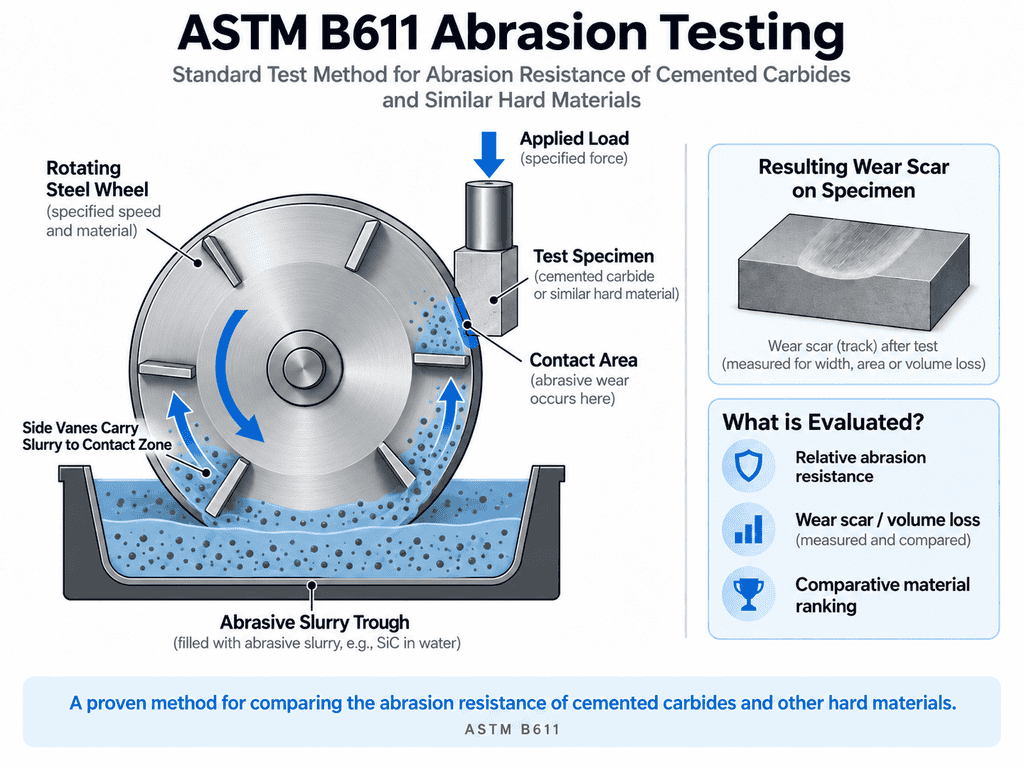
Unlike many abrasion tests (like G65) that use a rubber wheel, ASTM B611 uses a rotating steel wheel to force abrasive particles against the specimen. The contact stress is intentionally high enough to fracture or crush abrasive particles during the test. This produces a much more severe wear condition than conventional low-stress abrasion testing. The test uses a water slurry containing aluminum oxide abrasive. A flat specimen is pressed against the rotating steel wheel while the wheel carries abrasive slurry through the contact region. Material is progressively removed from the specimen, producing a characteristic wear scar.
After testing, the specimen is cleaned, dried, and weighed. Mass loss and material density are used to calculate wear volume. The result is a quantitative measurement of relative high-stress abrasion resistance, excellent for comparing relative performance of similar materials.
Why Is ASTM B611 Different From ASTM G65?
ASTM G65 and ASTM B611 both measure abrasive wear, but they simulate very different wear regimes:
- ASTM G65 uses a rubber wheel and dry sand. The compliant rubber wheel generally produces lower contact stresses, and most abrasive particles remain relatively intact.
- ASTM B611 uses a steel wheel and an abrasive slurry. Because the wheel is rigid, the contact stresses are high enough to fracture abrasive particles between the wheel and specimen.
That distinction is important. In tribological terms, ASTM B611 produces high-stress abrasion, while ASTM G65 is a low-stress abrasion test. ASTM specifically identifies the steel wheel and resulting abrasive fracture as the feature that distinguishes B611 from rubber-wheel methods such as ASTM G65 and G105.
For relatively soft metals, overlays, and many coatings, ASTM G65 may be the more appropriate comparison. For cemented carbides and other materials harder than approximately 55 HRC, ASTM B611 may provide much better discrimination between candidate materials.
How Is the ASTM B611 Test Performed?
The testing is very reproducible: a test specimen is mounted against a rotating steel wheel that is partially immersed in an aluminum-oxide/water slurry. Normally our trough is also covered on top to minimize splashing but this schematic shows how the process works:
During testing:
- The specimen is weighed before exposure.
- The test surface is placed against the steel abrasion wheel.
- A controlled force presses the specimen against the wheel.
- The wheel rotates through the aluminum oxide slurry.
- Abrasive particles are carried into the wheel/specimen contact.
- The high contact stress causes abrasive fracture and wear of the test material.
- After a specified number of wheel revolutions (usually 1000), the specimen is removed, cleaned, dried, and weighed again.
- Mass loss is converted to volume loss using the density of the test material.
The current ASTM B611 method provides two standard procedures based on wheel speed. Both use 1,000 revolutions: Procedure A operates at 100 rpm for approximately 10 minutes, while Procedure B operates at 50 rpm for approximately 20 minutes. A fresh abrasive slurry is used for each test to maintain consistent abrasive conditions. Afterwards the weight loss is converted to approximate volume loss, and additional optional testing may be performed on request.
What Does ASTM B611 Measure?
The primary test result is wear volume, normally reported in cubic millimeters. If the change in weight is :
where is the initial specimen mass and is the final mass, then the approximate wear volume is:
where is the material density. Lower wear volume indicates greater abrasion resistance.
This is particularly important when comparing cemented carbides because two materials may lose the same mass but have different densities. Comparing volume loss rather than mass loss gives a more physically meaningful measure of the amount of material removed. ASTM B611 therefore provides an excellent way to rank similar hard materials under controlled high-stress abrasive conditions.
What Materials Can Be Tested by ASTM B611?
ASTM B611 was developed specifically for cemented carbides but has also been successfully applied to several classes of very hard materials, including:
- Tungsten carbide-cobalt, WC-Co
- Tungsten carbide-nickel systems
- WC-Co-Cr and other mixed-binder carbide systems
- Cemented carbide drilling inserts
- Cermets
- Technical ceramics
- Metal-matrix composites
- Hardfacing alloys
- Weld overlays
- Thermal spray or similar hard deposits where sufficient thickness and hardness are available
- Other hard materials above approximately 55 HRC
The test is especially useful when relatively small differences in composition, carbide grain size, binder fraction, porosity, or processing route may produce significant differences in wear resistance.
ASTM B611 Testing for Tungsten Carbide
One of the most common uses of ASTM B611 is the comparison of tungsten carbide grades. Cemented carbide performance is not controlled by hardness alone. Wear resistance can vary significantly with carbide particle size, carbide volume fraction, binder chemistry, binder percentage, porosity, carbon balance, and microstructural defects.
For example, increasing cobalt binder content may improve fracture toughness but can reduce hardness and abrasive wear resistance. Refining WC grain size can increase hardness, but the complete wear behavior depends on the carbide-binder microstructure and the particular wear mechanism. ASTM B611 provides a useful quantitative metric for comparing these competing effects.
For drilling and oilfield applications, we can combine B611 abrasion testing with hardness, metallography, SEM/EDS, chemical composition, density, magnetic analysis, and other characterization methods to determine not only which carbide performs better, but why.
Where Is High-Stress Abrasion Important?
There are many applications where it’s critical including mineral extraction, rock drilling, crushing, slurry handling, comminution, recycling, and demolition equipment.
Typical components include:
- Drill bits and drilling inserts
- Downhole drilling tools
- Mining tools
- Crushing and grinding equipment
- Slurry pump components
- Wear plates
- Carbide cutting tools
- Hardfaced surfaces
- Choppers and shredders
- Mineral-processing equipment
- Earthmoving and demolition components
The method is especially useful where abrasive particles are trapped between hard surfaces under sufficiently high pressure that the abrasive itself fractures.
What Does a B611 Wear Scar Look Like?
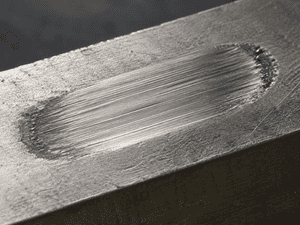
ASTM B611 produces a localized, elongated wear scar where the steel wheel presses the abrasive slurry against the specimen. Within the wear track, microscopic grooves, carbide pullout, binder removal, fracture, and other wear features may be visible depending on the material. Examining the wear scar can provide information beyond the numerical wear-volume result.
For example, in cemented carbides, SEM examination may reveal whether material removal is dominated by binder extrusion or removal, WC grain pullout, carbide fracture, microcracking, or combinations of these mechanisms. This can be extremely helpful when comparing alternative carbide grades that produce similar total wear values.
Can You Analyze the Wear Mechanism After B611 Testing?
Yes. US Corrosion can combine ASTM B611 abrasion testing with additional materials characterization to determine the mechanism responsible for wear.
Available follow-up analysis includes:
- Optical microscopy
- SEM imaging
- EDS elemental analysis
- Metallographic cross-sections
- Microhardness and hardness testing
- Chemical composition analysis
- Surface profilometry and wear-scar measurement
- Comparison of carbide grain size, binder distribution, porosity, and microstructure
This is particularly valuable during product development or supplier qualification because two materials with similar abrasion resistance may reach that result through very different microstructural mechanisms.
ASTM B611 for Supplier and Material Comparison
ASTM B611 is also an effective supplier qualification and quality-control test. If multiple vendors are supplying nominally equivalent tungsten carbide grades, B611 testing can be used to determine whether the actual wear performance is comparable.
A useful comparison program may include:
ASTM B611 abrasion resistance + hardness + density + chemical composition + metallography + SEM/EDS. Together, these measurements can identify whether a performance difference is associated with binder content, carbide grain size, porosity, processing defects, chemistry, or another material variable. This approach is especially useful when evaluating lower-cost alternative carbide suppliers or alternative binder chemistries.
ASTM B611 vs. Other Abrasion and Erosion Tests
No single abrasion test reproduces every service condition. The correct method depends on the actual wear mechanism.
- ASTM B611 is generally best for high-stress abrasion of very hard materials.
- ASTM G65 is commonly used for dry-sand, low-stress abrasion of metals, coatings, overlays, and wear-resistant materials.
- ASTM G75 evaluates slurry abrasion using a different wet-abrasion configuration.
- ASTM G76 evaluates erosion caused by solid particles carried in a gas stream.
- Taber abrasion testing is useful for many coatings, polymers, and comparatively thin surface systems.
Choosing the correct test is important because material rankings can change when the wear mechanism changes. If you are not sure whether ASTM B611, ASTM G65, ASTM G75, ASTM G76, Taber abrasion, or a customized test is most representative of your application, our engineers can help select the appropriate method(s) for your application.
ASTM B611 Testing in Houston, Texas
US Corrosion Services provides abrasion, wear, corrosion, metallurgical, and failure-analysis testing from our Houston laboratory. Our laboratory is located at 8307 Kempwood Dr. in Houston, near Highway 290, and works with customers throughout the United States and internationally. We can perform ASTM B611 as a standalone abrasion test or incorporate the results into a broader materials-development, supplier-comparison, or failure-analysis program.
Need ASTM B611 Testing or Help Comparing Hard Materials?
Send us information on the materials you are evaluating, the number and size of specimens, and the application they are intended for. If you are comparing tungsten carbide grades, binder systems, drilling-tool materials, hardfacing alloys, or alternative suppliers, let us know what question you are trying to answer. We can recommend the most useful combination of abrasion testing and materials characterization.
Need a quote? Contact the US Corrosion team and tell us about your ASTM B611 abrasion testing project.